
The Monetized Mindset: Transitioning Digital Skills into High-Margin Digital Consulting Services

The traditional employment contract is undergoing a profound structural dissolution. The illusion of corporate job security has been shattered by successive waves of algorithmic layoffs, corporate restructurings, and the rapid rise of artificial intelligence. In this volatile economic landscape, relying exclusively on a single source of W-2 corporate income represents a dangerous concentration risk. To build a truly anti-fragile financial foundation, professionals must diversify their revenue vectors. While the gig economy offers numerous low-barrier opportunities—such as ridesharing or micro-task freelancing—these ventures represent a flawed economic model: they commoditize your time, offering low margins and zero scalability.
The ultimate vehicle for generating sustainable, high-leverage side income is High-Margin Digital Consulting. This strategy demands that professionals step off the transactional freelance treadmill and instead productize their specialized corporate expertise—whether in software architecture, corporate strategy, digital marketing, or supply chain optimization—and sell it directly to business-to-business (B2B) clients globally. By transitioning from a tactical “doer” to a strategic “advisor,” you shift the economic pricing model from hourly wage dependency to value-based compensation, enabling the generation of substantial secondary cash flows that can match or exceed your primary salary without requiring a 60-hour work week.
The Structural Transition: Moving from Freelancing to Consulting
The fundamental failure of most professionals seeking side income lies in their inability to differentiate between freelancing and consulting. A freelancer is an outsourced execution mechanism. They are hired to perform a specific task—write a block of code, design a graphic layout, or audit a single spreadsheet. The client retains strategic control, viewing the freelancer as a fungible commodity and pricing their labor accordingly. This creates a destructive race to the bottom on global freelance platforms.
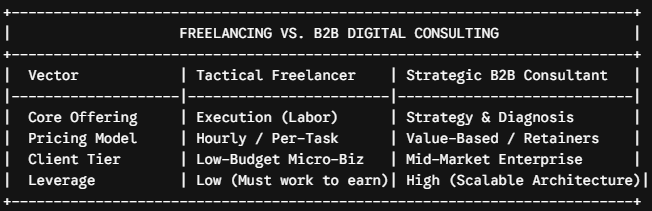
A digital consultant, conversely, operates as a diagnostic specialist. They do not sell their hands; they sell their brain. When a business experiences a systemic drop in conversion rates, operational inefficiencies, or technological bottlenecks, they do not need a technician to blindly execute commands—they need an expert to diagnose the root cause of the pathology and architect a definitive solution.
As a consultant, you position yourself as the partner who drives specific business outcomes (e.g., accelerating customer acquisition by 20% or cutting server overhead by $15,000 monthly). By framing your secondary income operation around measurable business value rather than hours spent at a keyboard, you unlock the capacity to charge premium corporate retainers, instantly shifting your side hustle into a high-margin enterprise.
The Blueprint for Productizing Specialized Expertise
Transforming your abstract daily corporate knowledge into a market-ready consulting offer requires a rigorous process of extraction and structural definition.
Step 1: Identifying the High-Value Core Competency
An effective consulting offer cannot be vague or all-encompassing. “Digital consulting” or “business advice” is entirely unmarketable. You must pinpoint a hyper-specific corporate pain point that businesses are actively spending significant capital to solve. If you work in corporate human resources, your offer isn’t “HR consulting”; it is “Engineering an Automated Onboarding Infrastructure to Reduce Developer Churn for Mid-Sized Tech Firms.” The tighter the niche, the higher the perceived authority and the lower the market competition.
Step 2: Structuring the Proprietary Roadmap
To justify premium pricing, your consulting service must be delivered through a structured, predictable process—a proprietary methodology. You must map out the exact chronological journey a client takes from their current state of dysfunction to their desired future outcome.
Breaking this journey down into distinct, predictable phases (e.g., Phase 1: Diagnostic Audit, Phase 2: Structural Optimization, Phase 3: Automated Integration) transforms your abstract intellectual property into a tangible, high-value product. This structural framing provides corporate decision-makers with absolute clarity and psychological safety, making budget approval a logical, low-risk decision.

Step 3: Calibrating the Value-Based Pricing Model
To maintain a side hustle without triggering rapid professional burnout, hourly billing must be strictly banned. If you charge $100 an hour, your earning potential is hard-capped by your remaining weekly leisure hours, forcing you to trade sleep for capital.
Instead, deploy Value-Based Fixed Pricing or Monthly Strategic Retainers. If your proprietary audit can optimize a client’s logistics pipeline and save them $100,000 over the next twelve months, pricing your strategic advisory package at a flat fee of $15,000 is an incredibly compelling proposition for the client. You might execute the diagnostic and deliver the roadmap in less than ten hours of actual cognitive input across a month, yielding an effective operational rate of $1,500 per hour. This is the ultimate mathematical leverage required to build substantial secondary wealth.
The Inbound Engine: Generating Clients Without Corporate Conflict
The primary anxiety holding professionals back from launching a high-end consulting side income operation is the challenge of client acquisition, combined with the necessity of maintaining strict boundaries with their primary corporate employer. You cannot spend your lunch breaks cold-calling prospects or risk violating non-compete agreements.
The solution is the construction of a passive, authoritative Inbound Content Engine, primarily anchored on professional networks like LinkedIn or specialized industry platforms. Instead of chasing clients, you publish high-value, deep-dive case studies and tactical breakdowns that systematically demonstrate your expertise. Write about how you solved complex industry problems, analyze macroeconomic trends affecting your niche, and break down systemic architectural failures you observe in the wild.
When your content provides undeniable, objective utility, corporate decision-makers (CEOs, VPs of Operations, Founders) will naturally discover your profile. By positioning your availability strictly around limited evening or weekend advisory slots, you maintain absolute professional compliance with your primary employer while forcing incoming prospects to compete for your highly constrained, premium advisory time.
Conclusion: Securing Financial Anti-Fragility
Transitioning your corporate skills into a high-margin digital consulting practice is the ultimate chess move for modern career resilience. It shatters the artificial ceiling placed on your earning potential by standard corporate salary bands and eliminates the systemic vulnerability of relying on a single employer.
When you successfully build a secondary income stream that commands premium enterprise rates, your relationship with your primary job changes fundamentally. You are no longer working out of fear or survival dependency; you are working out of choice. The capital generated can be directed completely into accelerating your long-term investment matrix, turning your specialized knowledge into a powerful, compounding engine for absolute financial sovereignty.