
The Automated Ecosystem: Structuring a Frictionless, Self-Managing Financial Engine

In the contemporary digital age, the greatest enemy of personal money management is not a lack of financial literacy, but the friction of execution. Human beings possess a finite amount of daily cognitive energy and willpower. When financial systems require continuous manual intervention—such as manually transferring funds to savings, actively paying individual bills, or logging into multiple portals to invest—they inherently invite human error, procrastination, and decision fatigue. A single stressful week at work or an unexpected personal distraction can cause the entire manual architecture to collapse, leading to missed payments, investment stagnation, and unmonitored lifestyle creep. To achieve optimal financial health, the focus must shift from manual discipline to structural automation.
The pinnacle of modern money management is the creation of an Automated Financial Ecosystem—a closed-loop, self-managing digital engine that automatically directs cash flows according to pre-established architectural rules the moment capital enters the system. By removing human emotion and active decision-making from the day-to-day mechanics of money, this ecosystem ensures that wealth accumulation, debt liquidation, and bill distribution occur flawlessly in the background. Automation transforms money management from a stressful monthly chore into a silent, hyper-efficient utility, liberating cognitive bandwidth so individuals can focus on expanding their income vectors rather than managing micro-transactions.
The Structural Blueprint: The Three-Tier Architecture
An anti-fragile automated ecosystem is anchored by a three-tier structural architecture, separating capital into distinct operational zones based on volatility, liquidity, and time horizons.
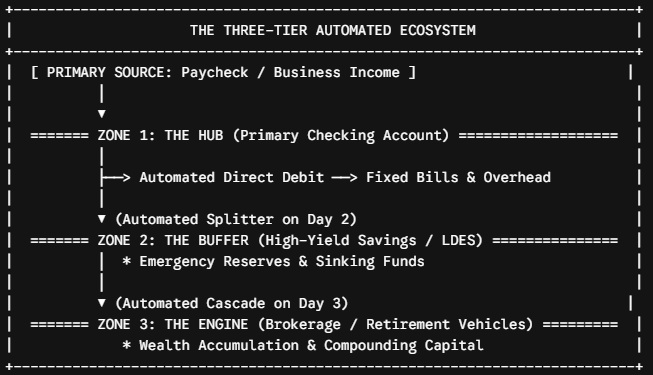
Zone 1: The Central Hub (The Automated Checking Account)
The Central Hub acts as the clearinghouse for your entire financial existence. All income streams—whether primary corporate direct deposits or secondary consulting revenues—must land exclusively in this highly liquid checking mechanism. The Hub is not designed to hold wealth; its structural purpose is to act as a traffic controller, maintaining a permanent operational baseline (typically calibrated to 1.5 times your monthly fixed expenses) to absorb minor transactional fluctuations.
Zone 2: The Safety Buffer (The High-Yield Savings Vault)
Positioned immediately adjacent to the Hub, the Safety Buffer houses your anti-fragile emergency reserves and non-monthly sinking funds. This tier utilizes a high-yield savings account (HYSA) or money market fund completely detached from your primary transactional bank to prevent psychological dipping. Capital flows automatically into this zone to maintain a dynamic baseline capable of withstanding systemic disruptions.
Zone 3: The Compounding Engine (The Investment Matrix)
The final destination for wealth creation is the Compounding Engine. This zone consists of tax-advantaged retirement accounts, automated robo-advisors, and self-directed brokerage clearinghouses. Capital entering this tier is immediately and automatically converted into productive, non-correlated assets (such as broad-market index funds or real estate syndications), ensuring it is structurally insulated from consumer spending temptations.
The Chronological Cascade: Setting the Rules of Transmission
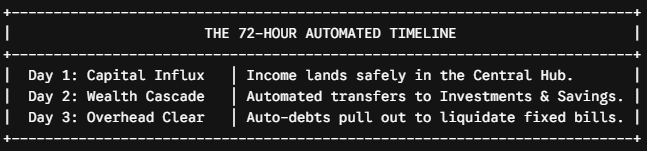
The magic of the automated ecosystem lies in the Chronological Cascade—the precise timing and logic assigned to the automated movement of capital. Setting up automatic transfers without aligning them with your cash-flow calendar is a recipe for overdraft catastrophes. The system must be engineered to execute sequentially, typically spanning a 72-hour window following your primary income drop.
Phase 1: The Payday Influx (Day 1)
Capital enters Zone 1. The primary checking mechanism recognizes the influx, triggering the baseline safety cushion. No money moves outward on this day, allowing the banking architecture time to clear the transaction fully.
Phase 2: The Fixed and Future Allocation (Day 2)
The automated splitters activate. Simultaneously, predetermined sums are pushed via automated ACH (Automated Clearing House) transfers into Zone 2 (Sinking Funds and Emergency Reserves) and Zone 3 (Retirement/Brokerage investments). By prioritizing these allocations within 24 hours of payday, you successfully execute the ultimate rule of personal finance: paying yourself first. You do not invest what is left after spending; you spend what is left after automated investing.
Phase 3: The Automated Overhead Clearing (Day 3 to 10)
With wealth and safety vectors securely funded, the remaining capital in the Central Hub clears fixed overhead liabilities. All predictable monthly bills—mortgage or rent payments, utilities, student loan minimums, and insurance premiums—are configured to auto-draft via direct debit or a dedicated cash-back credit card (which is itself set to auto-pay its full statement balance weekly). Discretionary spending capital remains in the Hub or is pushed to a secondary debit card dedicated strictly to lifestyle outlays, providing a rigid physical boundary for guilt-free consumption.
Behavioral Safeguards: Overcoming Technical Vulnerabilities
While an automated financial ecosystem dramatically reduces cognitive load, it introduces a dangerous systemic vulnerability: disconnection blindness. When a system manages itself, the user can easily lose touch with the operational reality of their money, leading to undetected lifestyle creep or ignored subscription leaks.
To bulletproof the system against this vulnerability, the architect must install behavioral safeguards:
- The Weekly Velocity Pulse: Set a recurring calendar invite every Sunday morning for exactly ten minutes. The user opens a unified net-worth aggregation app (like Monarch Money or Copilot) to review transaction flows across all tiers. This is not a budgeting session; it is an analytical audit to ensure the automation machinery is operating within normal parameters.
- The Income Spike Governor: Structure a rule where any unexpected windfall—bonuses, tax returns, or salary increases—is subjected to a “50/50 Split Rule.” Half is manually directed to accelerate the compounding engine, while the other half is merged into the Central Hub for discretionary optimization, balancing long-term growth with short-term psychological reward.
Conclusion: Achieving Frictionless Freedom
Designing and executing an automated financial ecosystem requires an initial investment of time, systematic planning, and meticulous digital engineering. However, once the pipework is connected and the rules are calibrated, the return on investment is extraordinary.
You effectively transcend the exhausting cycle of manual money tracking. Your wealth grows silently and relentlessly, your bills vanish before they can accumulate late fees, and your emergency buffer remains perpetually fortified—all without requiring a single conscious decision from you on a daily basis. By managing your money like an institutional asset manager rather than a chaotic consumer, you secure the ultimate luxury: the absolute peace of mind that comes from knowing your financial machinery is running flawlessly in the background, night and day.