
The Modern Portfolio Theory Reimagined: Asset Allocation Strategies for Inflationary Regimes

For nearly half a century, the cornerstone of institutional and retail wealth management has been built upon the foundations of Modern Portfolio Theory (MPT), introduced by economist Harry Markowitz in 1952. The fundamental premise of MPT is mathematically elegant and intuitively compelling: by assembling a diversified portfolio of non-correlated assets, an investor can maximize their expected returns for a given level of market risk. This philosophy culminated in the ubiquitous adoption of the classic 60/40 portfolio—an allocation model deploying 60% of capital into equities for capital appreciation and 40% into sovereign bonds for capital preservation and steady income yield. For decades, this model operated as an impenetrable shield, consistently delivering stable, inflation-adjusted returns through various market cycles.
However, the global macroeconomic landscape of the 2020s has fundamentally broken the core correlations that made the traditional MPT framework effective. An unprecedented regime of synchronized global monetary expansion, massive sovereign debt accumulations, structural labor shifts, and fracturing geopolitical supply chains has brought about the return of persistent, systemic inflation. In this new macroeconomic paradigm, the historical inverse relationship between stocks and bonds has repeatedly broken down; when inflation spikes, both equities and fixed-income assets frequently sell off simultaneously. To protect and grow capital in this volatile environment, sophisticated investors must discard outdated formulas and embrace a reimagined framework for asset allocation.
The Structural Failure of the Traditional 60/40 Portfolio
To understand why the legacy models are failing, one must examine the mechanics of bond behavior during inflationary spikes. Historically, sovereign bonds (such as US Treasuries or European Bunds) acted as a portfolio’s shock absorber. When equity markets crashed due to economic recessions, central banks routinely slashed interest rates, which drove bond prices up, offsetting the losses sustained in the stock portion of the portfolio.
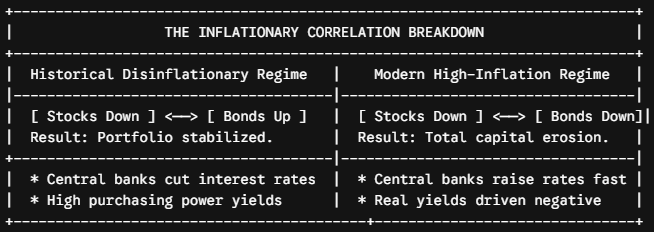
In a structurally high-inflation regime, this protective mechanism vanishes. When inflation runs significantly above central bank targets, monetary authorities are forced to aggressively raise benchmark interest rates to cool the economy. As interest rates surge, legacy bonds locked into lower yields suffer immediate, devastating capital losses.
Concurrently, equities lose their premium valuations as the discount rate applied to future corporate cash flows rises, causing stock prices to contract. Consequently, the correlation between stocks and bonds flips from negative to highly positive. The investor who relies blindly on the traditional 60/40 split finds themselves in a highly vulnerable position: experiencing simultaneous drawdowns in both asset classes while their remaining purchasing power is systematically eroded by inflation.
The Pillars of an Anti-Fragile Portfolio Allocation
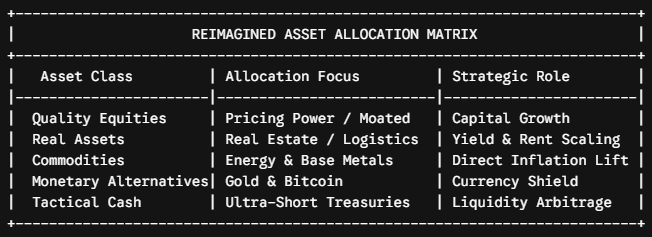
Reimagining portfolio construction for an inflationary era requires diversifying beyond the simple binary choice of traditional equities and fixed-income instruments. A resilient, modern asset allocation matrix must integrate alternative asset classes that possess intrinsic, structural mechanisms to hedge against rising prices.
Pillar 1: Equities with Absolute Pricing Power
Equities remain a crucial engine for long-term capital compounding, but indiscriminate index investing becomes a hazardous strategy during prolonged inflationary cycles. Broad index funds contain high concentrations of capital-intensive corporations that suffer heavily from rising input costs, supply chain blockages, and expanding labor expenses.
In an inflationary regime, tactical stock selection must prioritize companies possessing absolute pricing power. These are businesses that produce non-discretionary, essential goods or services, command dominant market shares, and boast high gross margins. Because their offerings are vital and lack direct substitutes, these corporations can seamlessly pass their rising operational costs onto the end consumer without experiencing a contraction in unit sales volume. Think of dominant consumer staples giants, critical infrastructure networks, and proprietary enterprise software ecosystems. These businesses act as natural inflation pass-through vehicles, allowing their dividends and earnings to scale dynamically alongside rising prices.
Pillar 2: Real Assets and Hard Commodities
True diversification in the modern era demands a significant structural allocation to real, tangible assets. Real estate—specifically residential multi-family housing and industrial logistics hubs—serves as an exemplary inflation hedge. Property values naturally appreciate as the nominal cost of building materials rises, while landlords can adjust lease structures rapidly to capture rising market rates, preserving real yields.
Furthermore, direct exposure to broad commodities—energy complexes (crude oil, natural gas), industrial base metals (copper, nickel), and agricultural goods—is vital. Inflation is often fundamentally driven by supply shocks within these very sectors; therefore, holding direct exposure to the underlying commodities transforms the driver of inflation into the driver of your portfolio’s capital appreciation.
Pillar 3: Monetary Metals and Sovereign Alternatives
Gold has functioned as humanity’s ultimate store of value for millennia, operating completely independent of counterparty risk or central bank manipulation. During periods where real interest rates (nominal interest rates minus the rate of inflation) are driven deep into negative territory, the opportunity cost of holding non-yielding gold drops to zero. Institutional capital flows into precious metals as a defensive sanctuary against sovereign currency debasement.
In the contemporary landscape, digital assets—most notably Bitcoin—are increasingly being evaluated by institutional asset managers as a digital alternative to gold. Due to its mathematically hard-capped supply of 21 million units, Bitcoin represents a highly liquid, non-sovereign, digital asset class that operates completely detached from the traditional banking system, offering a high-beta, asymmetric hedge against long-term fiat degradation.
The Mechanics of Dynamic Rebalancing
Assembling a modern, multi-asset portfolio is only the first phase of the wealth-preservation strategy. The true performance differentiator lies in the execution of a strict, unemotional rebalancing discipline. In an inflationary environment, asset classes exhibit intense volatility, with commodities and equities experiencing rapid, divergent price swings.
Traditional calendar-based rebalancing (e.g., checking allocations once a year on December 31st) is too slow to exploit these massive macro movements. Advanced portfolio managers deploy volatility-threshold rebalancing. Instead of tracking time, the investor establishes strict tolerance bands around each asset class allocation (e.g., a $\pm 5\%$ variance allowance).
When a massive surge in commodity prices causes that specific bucket to breach its upper ceiling, the investor immediately trims the profits from that overextended sector and reallocates the gains into out-of-favor, undervalued buckets like high-quality equities or monetary metals. This mechanical process forces the investor to systematically execute the ultimate rule of wealth creation: selling high and buying low, transforming market chaos into a permanent compounding machine.
Conclusion: The Imperative of Adaptation
The greatest hazard facing investors today is not market volatility, but cognitive inertia—the stubborn refusal to adapt verified historical strategies to completely altered structural realities. The investment frameworks that delivered immense wealth from 1980 through 2020 were optimized for a distinct historical epoch: a period defined by globalization, falling interest rates, and structural disinflation. That epoch has drawn to a definitive close.
Surviving and thriving in the new economic era demands an anti-fragile mindset. By shifting capital away from rigid, legacy formulas and constructing an intelligent portfolio anchored by high-pricing-power equities, tangible real assets, hard commodities, and sovereign monetary alternatives, you insulate your wealth from the destructive forces of inflation. The global economy is rewriting its rules in real-time; the investors who proactively rewrite their portfolios alongside it will be the ones who secure absolute financial sovereignty for the decades to come.