
The Liberation Blueprint: A Comparative Analysis of Snowball vs. Avalanche Debt Erasure Methods
In the landscape of modern personal finance, consumer debt functions as the single greatest drag on wealth accumulation. High-interest liabilities—ranging from predatory credit card balances and unsecured personal loans to compounding auto financing—effectively strip individuals of their primary wealth-building tool: their monthly income. Millions of households find themselves trapped in a perpetual cycle of minimum payments, watching their hard-earned liquidity dissolve into the balance sheets of financial institutions. To break this cycle and reclaim financial sovereignty, a passive approach to debt repayment is fundamentally useless. Reaching absolute debt freedom requires the implementation of a rigorous, mathematically sound, and psychologically sustainable framework.
The two undisputed heavyweight strategies in the realm of liability liquidation are the Debt Snowball and the Debt Avalanche methods. Both systems demand the same fundamental prerequisite: the budgeter must list all non-mortgage liabilities, maintain absolute consistency by paying the minimum required balance on every single account, and aggressively channel any available monthly surplus (known as the “debt snowflake”) toward one specific target account. However, the mechanism they use to select that primary target represents a profound philosophical divergence. The Debt Avalanche focuses strictly on mathematical optimization, while the Debt Debt Snowball prioritizes human behavioral psychology. Understanding the structural differences, tactical execution steps, and cognitive impacts of these two frameworks is essential for any individual engineering a definitive roadmap to absolute liberation.
The Debt Avalanche: The Calculus of Pure Mathematical Optimization
The Debt Avalanche method is the choice of the pure rationalist. In this framework, the investor lists all outstanding liabilities in descending order based strictly on their Annual Percentage Rate (APR), completely ignoring the absolute total dollar balance of each individual loan. The primary target account is unequivocally the debt carrying the highest interest rate. The budgeter funnels every extra dollar of available monthly cash flow into this highest-interest account until its balance is permanently reduced to zero, after which the entire financial force rolls downward to the account with the next highest interest rate.
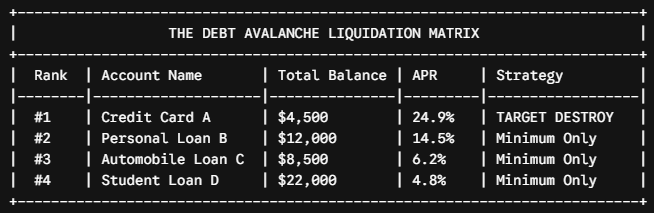
The mathematical advantage of the Debt Avalanche is indisputable. By prioritizing the most expensive capital first, the borrower minimizes the absolute amount of compounding interest paid over the lifespan of their debt-clearing journey. Every dollar allocated to a 24.9% APR credit card yields a guaranteed, risk-free return equal to that interest rate, preventing that toxic capital from compounding further against the household ledger.
For an individual possessing high mathematical discipline and emotional detachment, the Avalanche method guarantees the shortest possible chronological route out of debt and saves the maximum amount of raw currency. It treats debt elimination purely as an engineering problem to be optimized through spreadsheet efficiency.
The Debt Snowball: Engineering the Psychology of Momentum
The Debt Snowball method upends the mathematical priority model in favor of a human-centric behavioral architecture. Pioneered by personal finance experts who recognize that money management is driven far more by emotion than raw logic, the Snowball framework commands the borrower to list all debts in ascending order based strictly on the total outstanding balance, completely ignoring the interest rates. The primary target is the smallest account balance on the ledger.
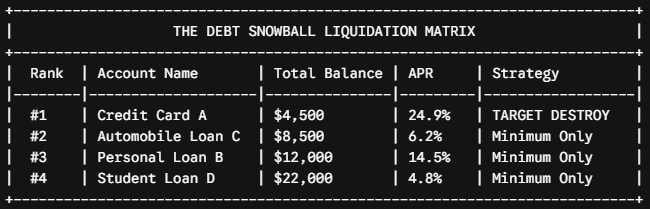
(Note: In this specific scenario, Credit Card A happens to be both the highest interest and lowest balance, making it the universal starting point. However, if Automobile Loan C was only $2,000, the Snowball would target it first, despite its low 6.2% interest rate).
From a purely mathematical perspective, the Debt Snowball is inefficient. If a borrower spends months attacking a tiny $1,000 medical bill at 0% interest while a massive $15,000 credit card balance continues to compound at 22%, they will pay more interest over time.
However, behavioral science reveals that human beings do not operate like emotionless computers. Debt fatigue is a major psychological barrier; when an individual struggles for months without seeing a tangible victory, their willpower erodes, frequently leading to abandonment of the strategy. The Debt Snowball combats this cognitive fatigue by providing rapid, early victories. Eliminating a small account entirely removes a line item from the ledger, frees up that account’s minimum payment to be rolled into the next target, and delivers a powerful surge of dopamine that reinforces the behavioral habit of debt clearance. As small accounts vanish, the monthly surplus growing behind the next target increases, creating an unstoppable psychological momentum—a snowball effect.
Behavioral Economics and the Friction of Long-Duration Goals
To choose between these two powerful systems, an individual must conduct an honest self-assessment regarding their psychological relationship with money. Behavioral economists highlight a cognitive bias known as Hyperbolic Discounting—the systemic tendency for humans to overvalue immediate rewards over long-term payoffs.
If a borrower chooses the Debt Avalanche but possesses a massive primary target (e.g., a $25,000 personal consolidation loan at 28% interest), it may take 18 to 24 months of relentless payment before that single account hits zero. For two years, the individual sees the exact same number of monthly bills arriving in the mail. The cognitive perception is one of stagnation, increasing the risk that the individual will lose motivation, succumb to debt fatigue, and revert to destructive spending habits.
Conversely, if that same individual deployed the Debt Snowball, they might completely eliminate three smaller accounts within those same first six months. The absolute number of monthly creditors drops from six to three. This tangible reduction in administrative clutter and financial overhead provides a profound psychological relief that structurally binds the individual to their debt-free roadmap. The optimal mathematical choice is irrelevant if the borrower lacks the psychological endurance to cross the finish line.
The Tactical Implementation Blueprint
Regardless of whether the borrower selects the pure mathematics of the Avalanche or the behavioral momentum of the Snowball, tactical execution must follow a flawless, zero-tolerance protocol.
Step 1: The Liquidity Audit and the Baseline Shield
Before a single extra dollar is paid toward a debt, the borrower must construct a basic liquidity shield—a starter emergency fund typically calibrated to one month of essential living expenses. Attempting to liquidate debt with zero liquidity reserves is an operational trap. The moment an unpredictable life event occurs—an automotive failure or medical deductible—the borrower will be forced to default on their strategy and pull out a credit card, immediately undoing their hard-earned progress and triggering psychological defeat.
Step 2: Freezing the Debt Engine
The borrower must permanently halt the accumulation of new liabilities. This requires a physical and psychological detachment from available credit lines. Credit cards must be removed from digital wallets, subscriptions must be audited, and lifestyle spending must be reduced to an absolute cash or debit baseline. You cannot dig your way out of a hole while simultaneously expanding its floor.
Step 3: Executing the Automated Cascade
The mechanics of the chosen method must be reinforced with automation. The borrower configures all non-target accounts to automatically execute their minimum required payments on payday, ensuring the household ledger remains in good standing and protected from late fees. The calculated monthly surplus is then manually or automatically deployed into the primary target account. The moment the target account hits absolute zero, it is closed permanently, and its entire minimum payment plus the surplus is redirected to the next account in the sequence.
Conclusion: Reclaiming Your Ultimate Financial Engine
The debate between the Debt Snowball and Debt Avalanche is ultimately a secondary consideration. The primary catalyst for wealth creation is the immediate, aggressive transition from financial passivity to deliberate action. Both methods are highly effective vehicles; the Avalanche optimizes the mathematical journey, while the Snowball secures the psychological framework necessary to endure it.
True financial security is built on the foundation of your monthly cash flow. When you systematically liquidate your liabilities, you are not merely clearing numbers off a spreadsheet—you are executing a hostile takeover of your own economic future. Every account balance that hits zero represents a direct raise to your disposable income and an expansion of your anti-fragile financial shield. Choose the vehicle that aligns with your psychology, automate the execution, maintain absolute discipline, and step forward into a life of absolute sovereign freedom.