
The FIRE Matrix: Engineering a Comprehensive Roadmap for Financial Independence and Early Retirement

The traditional industrial blueprint for a human life has remained virtually unchanged for over a century: enter the labor market in early adulthood, spend forty to forty-five years selling your cognitive and physical labor to corporate enterprises, systematically save a small fraction of your earnings in a regulated retirement account, and finally reclaim your personal time after age sixty-five. For generations, this narrative was accepted as a non-negotiable societal contract. However, the modern professional landscape has birthed a radical ideological rebellion against this prolonged deferral of life. This movement, known by the acronym FIRE (Financial Independence, Retirement Early), treats financial freedom not as a late-life luxury, but as an urgent engineering problem that can be solved through aggressive optimization of cash flows, hyper-efficient investment strategies, and deliberate lifestyle architecture.
At its core, the FIRE philosophy is deeply misunderstood by the mainstream public. Critics frequently dismiss it as an unsustainable lifestyle of extreme, painful deprivation or a fantasy reserved exclusively for high-earning tech elites. In reality, FIRE is a highly sophisticated framework of asset accumulation and safe withdrawal mechanics that grants individuals the ultimate asset: absolute autonomy over their time. Achieving financial independence does not mean you must spend the rest of your life sitting idle; it means that working becomes completely optional. You are liberated from the economic necessity of a paycheck, allowing you to pursue intellectual, creative, and philanthropic endeavors based purely on intrinsic desire rather than survival requirements.
The Mathematical Architecture: The Rule of 25 and The Safe Withdrawal Rate
The entire operational matrix of the FIRE movement rests upon a rock-solid mathematical pillar derived from the historic Trinity Study—a landmark academic paper published by researchers at Trinity University in 1998. The study analyzed decades of market performance data to determine the maximum percentage an investor could withdraw from a diversified portfolio annually without ever running out of capital over a multi-decade horizon. The consensus of this research established the foundational 4% Rule.
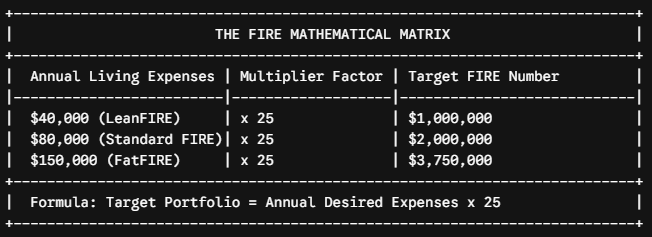
To engineer your personal roadmap to financial independence, you must inverse this rule, resulting in what is known as the Rule of 25. First, an individual must establish their true annual operational overhead—the absolute baseline cost required to fund their desired lifestyle. Multiplying this annual expenditure by 25 yields the precise target portfolio size—the “FIRE Number”—required to cross the threshold into permanent economic sovereignty.
Once your invested assets cross this calculated threshold, the laws of compounding interest and historical market returns enable you to safely withdraw 4% of the total balance in year one, adjust the payout value for inflation annually thereafter, and maintain a highly statistical probability that the portfolio will outlive you. The focus shifts entirely away from arbitrary age milestones to a single, clear mathematical destination.
The Dialects of Freedom: Navigating the FIRE Archetypes
As the movement has matured globally, it has evolved from a monolithic doctrine into a diverse ecosystem of strategies tailored to different risk tolerances, income baselines, and lifestyle aspirations. Wealth architects generally categorize these paths into three distinct operational dialects.
1. LeanFIRE: High-Efficiency Minimalist Optimization
LeanFIRE is designed for individuals who prioritize time freedom above all consumer comforts. Practitioners of this dialect intentionally design an ultra-lean, highly efficient lifestyle, typically keeping annual expenditures below $40,000. By choosing alternative housing options, rejecting consumer status symbols, and adopting extreme lifestyle optimization, they can achieve their FIRE targets rapidly—often within seven to ten years on a modest salary. The core philosophy here is simple: reducing your expenses by half doesn’t just double your savings rate; it simultaneously slashes your ultimate target portfolio goal by 50%.
2. FatFIRE: Uncompromised Abundance and Wealth Accumulation
FatFIRE is the preference of high-earning professionals, entrepreneurs, and asset managers who refuse to compromise their standard of living in retirement. Practitioners aim to support an abundant lifestyle, with annual expenditures frequently exceeding $100,000 to $150,000. Achieving FatFIRE requires the cultivation of high-margin skill sets, aggressive corporate scaling, or business ownership, alongside the construction of massive multi-million dollar portfolios. This archetype provides a wider safety margin against market drawdowns and allows for luxurious living, travel, and generational wealth transfers.
3. CoastFIRE & BaristaFIRE: The Transitional Arbitrage
For those who wish to exit the high-stress corporate rat race immediately without waiting decades to build a full portfolio, CoastFIRE and BaristaFIRE offer brilliant transitional mechanics. CoastFIRE is achieved when an individual aggressively saves a substantial sum early in life, allowing that capital to sit in equity markets undisturbed for decades. Once the current balance is mathematically guaranteed to compound into a full FIRE number by traditional retirement age without another dollar added, the individual can “coast.” They can quit their corporate job and work any low-stress, enjoyable occupation simply to cover their current daily living expenses. BaristaFIRE involves accumulating a partial portfolio that allows the individual to work part-time or take a lower-paying role that provides vital health insurance benefits, relying on portfolio dividends to supplement their lifestyle income.

The Core Engine: Maximizing the Savings Rate Vector
The primary accelerator of the journey to financial independence is not asset selection or market timing; it is your Savings Rate—the percentage of your net take-home income that is successfully preserved and deployed into productive investments. Traditional personal finance advocates a passive 10% savings rate, a trajectory that requires roughly nine working years to fund a single year of retirement.
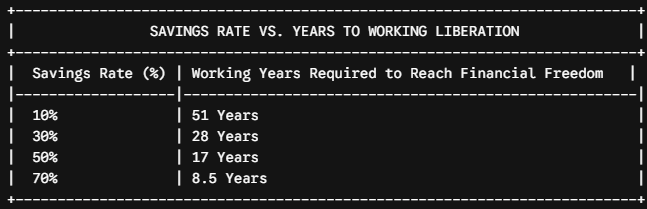
The mathematical truth revealed by this chart is liberating: your timeline to early retirement is completely independent of your absolute income bracket. A professional earning $60,000 who maintains a 50% savings rate will achieve absolute financial freedom in the exact same 17 years as an executive earning $300,000 who saves 50%. To accelerate this timeline, the FIRE architect operates a dual-engine strategy: Aggressive Income Scaling (climbing the corporate ladder, launching high-margin side hustles) combined with Vigilant Overhead Suppression (preventing lifestyle creep). By widening the gap between income and expenses, you create an enormous capital surplus that speeds up the compounding engine exponentially.
Mitigating Systemic Risks: Sequence of Returns Risk and the Safety Buffer
Transitioning from asset accumulation to early retirement introduces severe macroeconomic vulnerabilities that do not affect traditional retirees. The most dangerous of these is Sequence of Returns Risk (SRR). If an early retiree leaves the workforce and the stock market immediately enters a prolonged bear market during the first three years of their withdrawal phase, selling depressed assets to fund living costs will permanently cripple the portfolio’s structural capacity to recover.
To insulate oneself against SRR, a sophisticated FIRE roadmap must integrate robust safety buffers:
- The Cash/Bond Cushion: Maintaining one to two years of living expenses in absolute cash equivalents or ultra-short-term yield instruments. During equity market crashes, the retiree draws down this cash reserve completely, leaving their core stock investments untouched and allowing them full structural room to recover.
- Dynamic Variable Withdrawals: Rejecting a rigid 4% withdrawal pattern in favor of an adaptive guardrail strategy. If the market experiences a substantial correction, the early retiree immediately scales back discretionary outlays, lowering their withdrawal rate to 3.25% or 3.5% until market equilibrium is restored.
Conclusion: Reauthoring the Human Narrative
The FIRE movement is ultimately far grander than a collection of savings hacks or retirement calculators; it is a profound philosophical reclamation of human agency. Money is a renewable resource; time is absolutely finite. Selling your healthiest, most vibrant decades to an unfulfilling corporate desk simply to purchase consumer goods you do not need is a tragic misallocation of human life.
By engineering a meticulous FIRE matrix, you break free from the invisible chains of modern wage dependency. It demands structural shifts in your worldview, the courage to reject societal consumer metrics, and consistent discipline over a decade or more. But the destination is an existence of uncompromised liberty—a life where you wake up every morning possessing absolute sovereign ownership over your time, your calendar, and your destiny.