
Demystifying the Algorithm: A Professional Guide to Optimizing Your FICO Score from Scratch

In the modern financial ecosystem, your credit score is not merely a reflection of your past borrowing habits; it is a critical financial gatekeeper. A FICO score operates as an algorithmic filtration system used by institutional lenders, insurers, landlords, and even corporate employers to evaluate your systemic risk profile. Navigating the consumer credit landscape without a precise, mechanical understanding of how this algorithm computes risk is equivalent to playing a high-stakes game with blindfolds on. A poor or non-existent credit score acts as a silent tax on your financial life, forcing you to endure exorbitant interest rates, outright loan denials, and inflated insurance premiums that systematically drain your household cash flow.
Conversely, a pristine, optimized credit profile functions as a powerful wealth-building lever. It grants you access to prime capital at the lowest possible cost, allowing you to utilize other people’s money (OPM) to acquire cash-flowing real estate or scale business operations with maximum efficiency. Building elite credit from absolute scratch—or rehabilitating a damaged profile—is not a matter of luck or passing time. It is a highly predictable engineering exercise that requires strategic manipulation of the specific algorithmic vectors that govern credit scoring models. By deconstructing the mathematical components of the FICO architecture, any individual can implement a deliberate, tactical blueprint to vault their score into the elite tier.
Deconstructing the FICO Core Components
To optimize the algorithm, you must first map its structural parameters. The standard FICO scoring model calculates creditworthiness based on five distinct, non-negotiable weight categories.
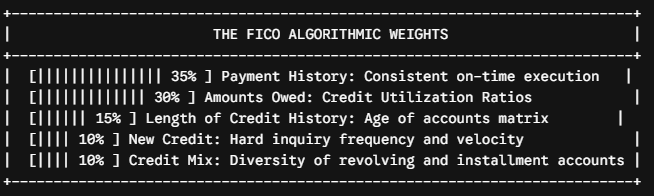
Vector 1: Payment History (35% Weight)
The single heaviest pillar of the FICO matrix evaluates your historical reliability. The algorithm looks for binary execution: did you pay at least the minimum required balance on time, every single month? A single 30-day delinquency can trigger an immediate, catastrophic drop of 50 to 100 points, permanently scarring your profile for seven years. Absolute, uncompromised automation of minimum payments is the non-negotiable baseline shield for this vector.
Vector 2: Credit Utilization Ratio (30% Weight)
This category measures your dynamic debt load relative to your total available credit limits. The math is stark: if you possess a credit card with a $10,000 limit and carry a balance of $9,000, your utilization is 90%, signaling to the algorithm that you are under severe financial stress. To maximize points within this vector, your utilization must be suppressed below 10% on both individual cards and across your aggregate credit limits, regardless of whether you pay the balance in full every month.
Vector 3: Length of Credit History (15% Weight)
Time is an unskippable constraint in the FICO matrix. The algorithm calculates the average age of all your open accounts, alongside the age of your oldest active account. Closing your oldest credit cards out of a misguided desire to “simplify your finances” is a tactical error; it shortens your historical timeline, causing the average age vector to contract and your score to instantly drop.
Vector 4: New Credit & Inquiries (10% Weight)
Every time you actively apply for a new line of credit, the lender executes a “Hard Inquiry” to pull your file. The algorithm views a rapid succession of hard inquiries within a short window as a major red flag, interpreting it as “credit hunger”—a behavioral indicator of impending financial distress. Strategic optimization requires restricting applications to high-utility vehicles and pacing them at least six months apart.
Vector 5: Credit Mix (10% Weight)
The algorithm rewards diversity. A borrower who only manages revolving credit (credit cards) is viewed as less proven than an individual who successfully manages a balanced mix of revolving accounts and installment loans (mortgages, auto financing, or student loans).
The Tactical Step-by-Step Blueprint for Building Credit from Scratch
For a “credit invisible” individual—such as a young professional, an immigrant, or someone who has historically avoided debt—the initial challenge is structural: you cannot get credit because you don’t have a score, and you don’t have a score because you cannot get credit. To shatter this paradox, you must execute a specific sequence of low-risk, entry-level credit hacks.
Step 1: The Secured Card Pipeline
The most reliable gateway into the credit ecosystem is the Secured Credit Card. Unlike traditional credit cards, a secured card requires you to place a cash deposit with the issuing bank (e.g., $500), which then serves as your collateral and matches your credit limit. Because the bank faces zero default risk, approval is virtually guaranteed.
The strategic execution is vital: you do not use this card for daily consumption. Instead, link a single, low-cost recurring subscription (like a $15 streaming service) to the card, configure the card’s bank portal to automatically pay the balance in full from your checking account every month, and place the physical card inside a drawer. This establishes a permanent, automated machine that pumps flawless, on-time payment data into the credit bureaus month after month with zero risk of overspending.
Step 2: Leveraging Credit Builders and Piggybacking Mechanics
If you have zero access to upfront deposit capital, you can utilize Credit Builder Loans. These are digital micro-installment setups where a specialized financial institution moves a small loan amount (e.g., $1,000) into a locked savings account that you cannot access. You make small monthly payments (e.g., $50) over a year, which the lender reports to the bureaus as a perfect installment history. At the end of the term, the lock is removed, and the money is returned to you.
Alternatively, if you possess a family member with an elite credit profile, you can utilize the Authorized User Hack (Piggybacking). By adding your name to their oldest, perfect-history credit card as an authorized user, that card’s entire multi-year payment history and massive credit limit are instantly mapped onto your new credit report, providing an immediate, algorithmic launchpad to your score.

Advanced Optimization: Managing the Statement Date Illusion
For individuals aiming to push their score from the mid-700s into the elite 800+ tier, a deep operational understanding of the Statement Closing Date vs. Due Date is required.
Almost all consumers assume that if they pay their credit card bill in full by the official due date, their credit utilization is reported as 0%. This is an illusion. Banks report your outstanding balance to the credit bureaus on your Statement Closing Date, which occurs roughly three weeks before your due date. If you spend $3,000 on a card with a $5,000 limit, and wait for the monthly statement to arrive before paying it off, the bank reports a 60% utilization rate to FICO. Even though you pay it to zero on the due date and incur no interest, the algorithm penalizes you for a massive debt load.
To bypass this trap, execute the Mid-Cycle Payment Strategy. Log into your credit portal and pay your balance down to less than 5% of your total limit exactly three days before the statement closing date. When the bank runs its monthly data export to the credit bureaus, it will capture an ultra-low utilization profile, maximizing your FICO points while allowing you to continue utilizing the card’s cash-back benefits normally.
Conclusion: The Shield of Economic Mobility
An elite credit score is not a metric of consumer vanity; it is an invaluable financial asset that must be built with intent and guarded with absolute vigilance. It transforms you from a powerless supplicant begging traditional institutions for capital into a high-leverage market participant dictating terms to lenders.
By mastering the specific weights of the FICO algorithm, automating your payment layers, managing statement cycles aggressively, and maintaining a diverse, aged matrix of accounts, you construct a flawless financial reputation. This reputation acts as a powerful accelerator for your broader wealth-building engine, opening doors to prime real estate opportunities, secure investments, and capital mobility that form the core blueprint of long-term financial sovereignty.