
The Architecture of Abundance: Mastering Zero-Based Budgeting in a Volatile Economy

In an era characterized by turbulent economic shifts, persistent inflationary pressures, and unpredictable job markets, the traditional methods of personal finance are proving fundamentally inadequate. For decades, the standard financial advice to retail consumers was deceptively simple: track your spending, save a nominal percentage of your net income, and leave the rest to passive accumulation. However, this reactionary approach to money management offers no defense against systemic macro volatilities. To build true financial resilience, individuals must shift from passive tracking to active capital allocation. The pinnacle of this proactive approach is Zero-Based Budgeting (ZBB)—a rigorous, highly strategic framework that demands every single dollar of income be given a specific, justified purpose before it is spent.
Historically pioneered by corporations to eliminate waste and optimize operational efficiency, Zero-Based Budgeting has undergone a profound transformation when translated into personal financial management. It is not merely a tool for restriction or economic austerity; rather, it is a sophisticated system of financial architecture that transforms cash flow from a chaotic, escaping stream into an optimized, highly directed engine for wealth creation. By forcing an individual to reset their financial baseline to zero every month, ZBB strips away the complacency of historical spending habits, laying bare the true opportunity cost of every consumer decision.
The Core Philosophy: The Zero-Sum Mandate
The mathematical foundation of Zero-Based Budgeting is expressed through a deceptively straightforward equation:

To the uninitiated, this formula suggests a dangerous paradox: that the budgeter is intentionally aiming to deplete their entire net worth by the end of the monthly cycle. This is a fundamental misunderstanding. In the context of ZBB, an “expense” is not defined solely as consumer consumption, bills, or discretionary outlays. Instead, an expense represents any allocation of capital out of the primary checking mechanism, which explicitly includes high-yield savings deposits, retirement vehicle contributions, brokerage investments, and debt liquidation allocations.
Therefore, achieving a balance of zero does not mean your bank account is empty. It means that every single unit of currency that entered your ecosystem has been actively deployed to a specific economic front. When you refuse to leave unallocated margins floating in a primary account, you effectively eliminate the phenomenon known to behavioral economists as “frictionless drift”—the subconscious tendency to spend idle funds on low-utility items simply because the capital is readily visible and accessible. In a zero-based framework, idle cash is treated as an operational failure; every dollar must work, whether it is purchasing groceries, paying down a mortgage, or buying shares of an index fund.
The Tactical Execution Blueprint
Executing a successful personal Zero-Based Budget requires a systematic, chronological approach that must be performed prior to the commencement of each calendar month. The process cannot be retroactively calculated based on past bank statements; it must act as a predictive architectural blueprint for future behavior.
Step 1: Establishing the Net Income Baseline
The architecture begins with an absolute calculation of your net liquidity for the upcoming month. This includes all predictable income streams: primary corporate salaries, consistent freelance retainers, dividend distributions, and verified secondary cash flows. For individuals operating with variable incomes—such as commission-based sales professionals or gig-economy entrepreneurs—the baseline must be calculated using a conservative historical average or, preferably, the minimum guaranteed floor income from the past twelve months. Any income generated above this calculated floor during the month is systematically funneled directly into secondary savings or investment buckets at the end of the cycle, keeping the core budget engine stable.
Step 2: Granular Expense Categorization and Sinking Fund Integration
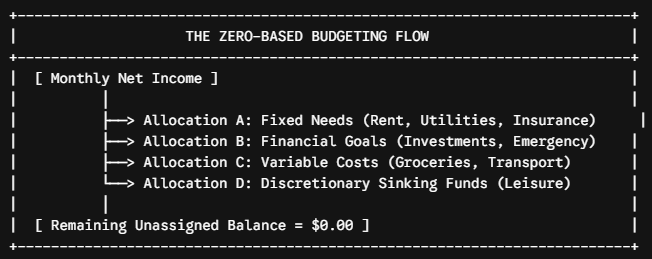
Once the income ceiling is established, the budgeter constructs their allocation tiers. These are broken down into three distinct, non-negotiable vectors: Fixed Obligations (housing, debt minimums, contractual utilities), Variable Necessities (groceries, fuel, healthcare outlays), and Long-Term Targets (retirement funds, brokerage capital).
The critical operational innovation within this step is the integration of “Sinking Funds.” Traditional budgets often collapse when faced with non-monthly, irregular expenses such as annual car insurance premiums, quarterly tax obligations, or sudden medical deductibles. ZBB neutralizes these disruptions by breaking down annual liabilities into twelve equal monthly micro-allocations. If your automobile insurance costs $1,200 annually, the zero-based architect creates a permanent monthly expense bucket of $100. This capital is moved out of the primary pool into a dedicated sub-account every month, ensuring that when the major bill arrives, it is met with zero financial friction or stress.
Step 3: The Zero-Sum Balancing Act
With income and expense forecasts established, the actual balancing occurs. The budgeter subtracts the categories from the income baseline. If the resulting figure is positive, it indicates that capital remains unassigned; this surplus is immediately funneled into high-priority financial goals, such as accelerating debt payments or boosting stock investments, until the equation hits exactly zero. If the figure is negative, the budget is in deficit, requiring a structural line-item audit. The budgeter must surgically trim discretionary lines (dining out, entertainment subscriptions, luxury upgrades) until the income and expense vectors achieve absolute mathematical parity.
Behavioral Psychology: Overcoming Cognitive Bias
The ultimate value of Zero-Based Budgeting lies not in its mathematical precision, but in its profound impact on human behavioral psychology. Human beings are inherently susceptible to cognitive biases that actively sabotage long-term financial health. The most destructive of these is the Endowment Effect combined with Mental Accounting—the tendency to view money differently based on its source or how it is loosely categorized in the mind.
Traditional budgets allow for “cushions”—arbitrary pools of unallocated cash left in a checking account to provide a sense of security. Behavioral studies demonstrate that these cushions act as psychological invitations for lifestyle creep. When a consumer looks at an account and sees a vague surplus, their brain classifies this capital as “free money,” lowering the emotional friction required to justify an impulsive, non-essential purchase.
ZBB disrupts this cognitive flaw by implementing strict accountability. Because every dollar is explicitly named and bound to a specific destiny before the month begins, spending an extra $50 on an impulse purchase requires a conscious, painful trade-off. The consumer cannot pull from a vague cushion; they must explicitly open their budgeting matrix and decide which named bucket—such as “Summer Vacation Fund” or “Emergency Reserve”—they are willing to cannibalize to fund that temporary impulse. This structural friction forces the brain to evaluate the true opportunity cost of spending, turning passive consumers into highly deliberate asset managers.
Mitigating the Friction: Tool Selection and Automation Strategies
A primary criticism leveled against Zero-Based Budgeting is its administrative intensity. Detractors argue that tracking every single transaction down to the cent and constantly resetting allocation matrixes is exhausting, leading to psychological burnout within the first ninety days. While this risk is real, it can be entirely mitigated through the deployment of modern financial software and intentional automation ecosystems.
The contemporary financial landscape offers powerful dedicated digital platforms designed explicitly around the zero-based framework (such as YNAB – You Need A Budget, EveryDollar, or custom-engineered automated spreadsheets). These tools securely sync with bank feeds, allowing for rapid, near-instantaneous categorization of transactions.
To achieve maximum efficiency without sacrificing the psychological benefits of active decision-making, professional wealth builders utilize a hybrid automation model:
- Fixed and Investment Automation: Contractual obligations and retirement investments are set to automatically auto-draft from the primary account immediately following payday. This ensures that the wealth-building engine operates flawlessly without requiring manual human intervention.
- Variable Allocation Monitoring: For volatile, human-centric categories like groceries, dining, and lifestyle purchases, automation is rejected in favor of active, deliberate manual logging. Utilizing mobile applications to input these expenditures at the point of sale maintains the crucial psychological feedback loop, ensuring the budgeter remains intimately aware of their shrinking capital pools throughout the month.
Conclusion: The Path to Absolute Sovereignty
Ultimately, Zero-Based Budgeting should not be viewed as a financial prison sentence, but rather as the ultimate vehicle for personal economic sovereignty. Financial anxiety rarely stems from a lack of gross income; instead, it is born from the profound sense of helplessness that accompanies unmanaged, chaotic cash flow. Watching a substantial salary dissolve month after month into a black hole of unmonitored consumer spending is a deeply demoralizing experience that leaves individuals acutely vulnerable to economic volatility.
By adopting a zero-based architecture, you seize absolute control over your financial narrative. You transition from a passive spectator wondering where your money went, to an assertive commander telling your money exactly where to go. It requires discipline, initial administrative effort, and a willingness to confront your spending realities face-to-face. But the reward is an unparalleled sense of financial clarity, the rapid acceleration of your long-term wealth targets, and the construction of an anti-fragile financial shield capable of weathering any economic storm the future may bring.