
Target-Date Horizons: Aligning High-Value Goals with Modern Market Realities

The pursuit of financial sovereignty is rarely a linear journey focused exclusively on distant, decades-away objectives like early retirement. A comprehensive personal wealth strategy must successfully navigate a complex matrix of shifting chronological horizons. Throughout their active career, an individual will confront numerous high-value, non-negotiable financial milestones within the short-term (1 to 3 years) and medium-term (3 to 7 years) windows. These goals include securing the down payment for a primary residence, accumulating startup capital for a business venture, or funding private education for dependents.
The critical planning error made by the general public is the implementation of a mono-investment strategy—applying the exact same asset allocation model to every financial goal regardless of its timeline. Depositing short-term house down payment capital into volatile equity index funds is an operational gamble that exposes the household ledger to catastrophic market drawdown risk right when liquidity is required. Conversely, hoarding medium-term business capital in low-yield checking mechanisms ensures that inflation systematically erodes its real purchasing power. Overcoming this requires the execution of a Target-Date Horizon Framework—surgically matching the duration and risk profile of your investment vehicles to the exact calendar date of your upcoming liabilities.
The Chronological Asset Matching Matrix
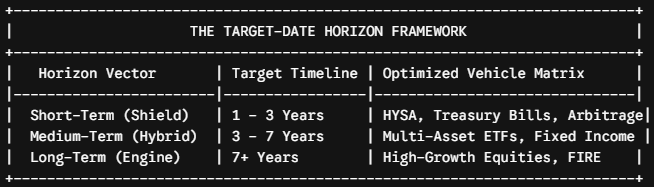
An optimized financial roadmap separates capital into distinct risk-mitigated silos, adjusting the volatility threshold as the target date approaches.
The Short-Term Vector (1 to 3 Years): The Capital Preservation Zone
When a high-value financial goal is positioned within a 36-month window, your primary operational objective transforms from capital appreciation to absolute capital preservation. The financial markets are inherently erratic across short horizons; a sudden geopolitical event or macroeconomic shift can trigger a 20% contraction in equity indexes that can take years to recover.
Therefore, short-term goal capital must be strictly insulated from equity market volatility. The optimal vehicles for this zone are ultra-secure, highly liquid, cash-equivalent instruments:
- High-Yield Savings Accounts (HYSAs): Offering instant liquidity combined with competitive yields that scale with central bank interest rates.
- Treasury Bills (T-Bills): Short-term sovereign debt obligations backed by the full faith of the state, providing risk-free yields completely exempt from state and local tax liabilities.
- Short-Duration Certificates of Deposit (CDs): Locking in yield guarantees when the macro-outlook suggests an impending decline in benchmark interest rates.
The Medium-Term Vector (3 to 7 Years): The Balanced Hybrid Zone
The medium-term horizon represents the most complex strategic challenge. With a timeline spanning three to seven years, saving purely in cash guarantees that your capital will lag behind real-world inflation, making your ultimate goal more expensive over time. However, going full throttle into high-growth tech stocks remains unacceptably risky, as severe market cycles can take up to five years to break even.
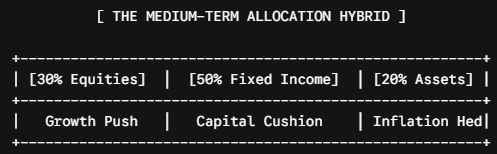
The solution is the construction of a Conservative Multi-Asset Hybrid Portfolio. This allocation matrix blends low-volatility global equities with short-to-medium-term fixed-income instruments and real assets. A classic configuration involves deploying 30% into broad-market index funds (for an inflation beat), 50% into high-quality corporate bonds or government notes (for yield stability), and 20% into diversified real estate investment trusts (REITs) or commodities. This structural balance cushions the portfolio against steep drawdowns while ensuring the underlying capital grows at a velocity that maintains real purchasing power parity.
The Long-Term Vector (7+ Years): The Compounding Engine
Once a financial target crosses the seven-year threshold, the short-term noise of the markets becomes strategically irrelevant. Over a historical ten-year horizon, diversified equity markets boast a near-flawless record of positive, compounding returns. Long-term goals—such as launching a late-career venture or building a real estate acquisition fund—can be deployed aggressively into 100% equity configurations, aggressive growth sectors, and alternative alphas, allowing the unstoppable force of compounding interest full operational room to run.
The Glidepath Strategy: Dynamic De-risking Over Time
The crucial, final component of the horizon framework is the implementation of a Dynamic Glidepath. Your financial goals are not static; a medium-term target of buying a home in five years will inevitably transition into a short-term target of buying a home in twelve months. If your portfolio allocation does not automatically shift alongside this chronological progression, you remain acutely exposed to sudden market shocks right before crossing the finish line.
To execute a glidepath strategy, the wealth builder establishes an annual de-risking calendar. Every twelve months, the portfolio is systematically audited and rebalanced to reflect its updated proximity to the target date.
If a medium-term goal portfolio began as a 40/60 stock-to-bond split, by year three the architect begins transferring a calculated percentage out of volatile equities and long-term bonds, locking the funds directly into risk-free, ultra-liquid Treasury Bills or HYSAs. By the time you enter the final twelve months before the down payment contract is signed, the entire capital pool has seamlessly transitioned into absolute liquidity, completely insulated from market panics, allowing you to deploy the funds exactly on schedule with absolute peace of mind.
Conclusion: Achieving Temporal Alignment
True mastery of personal money management requires the capacity to balance multiple competing timelines simultaneously. Financial failure is rarely caused by choosing the wrong stock or using the wrong app; it is born from a fundamental mismatch between the timeline of your life goals and the duration risk of your financial assets.
By implementing a strict Target-Date Horizon Framework, you eliminate the destructive element of chance from your short and medium-term aspirations. You protect your imminent obligations with an unbreachable shield of absolute liquidity, while simultaneously empowering your future aspirations with high-leverage compounding engines. This structured, disciplined approach ensures that every milestone in your life’s journey is met with adequate, optimized capital, turning abstract personal dreams into predictable, mathematical certainties.